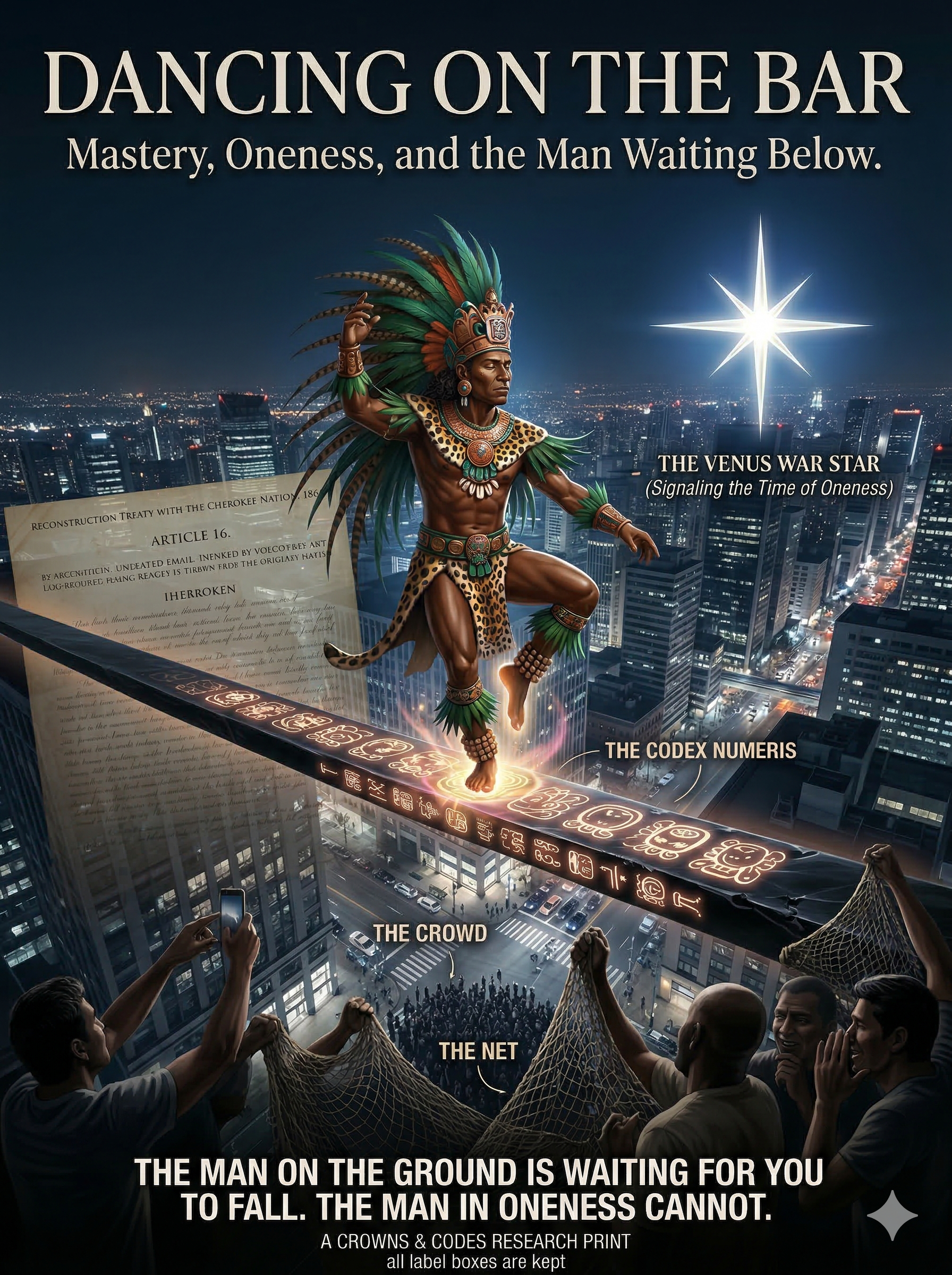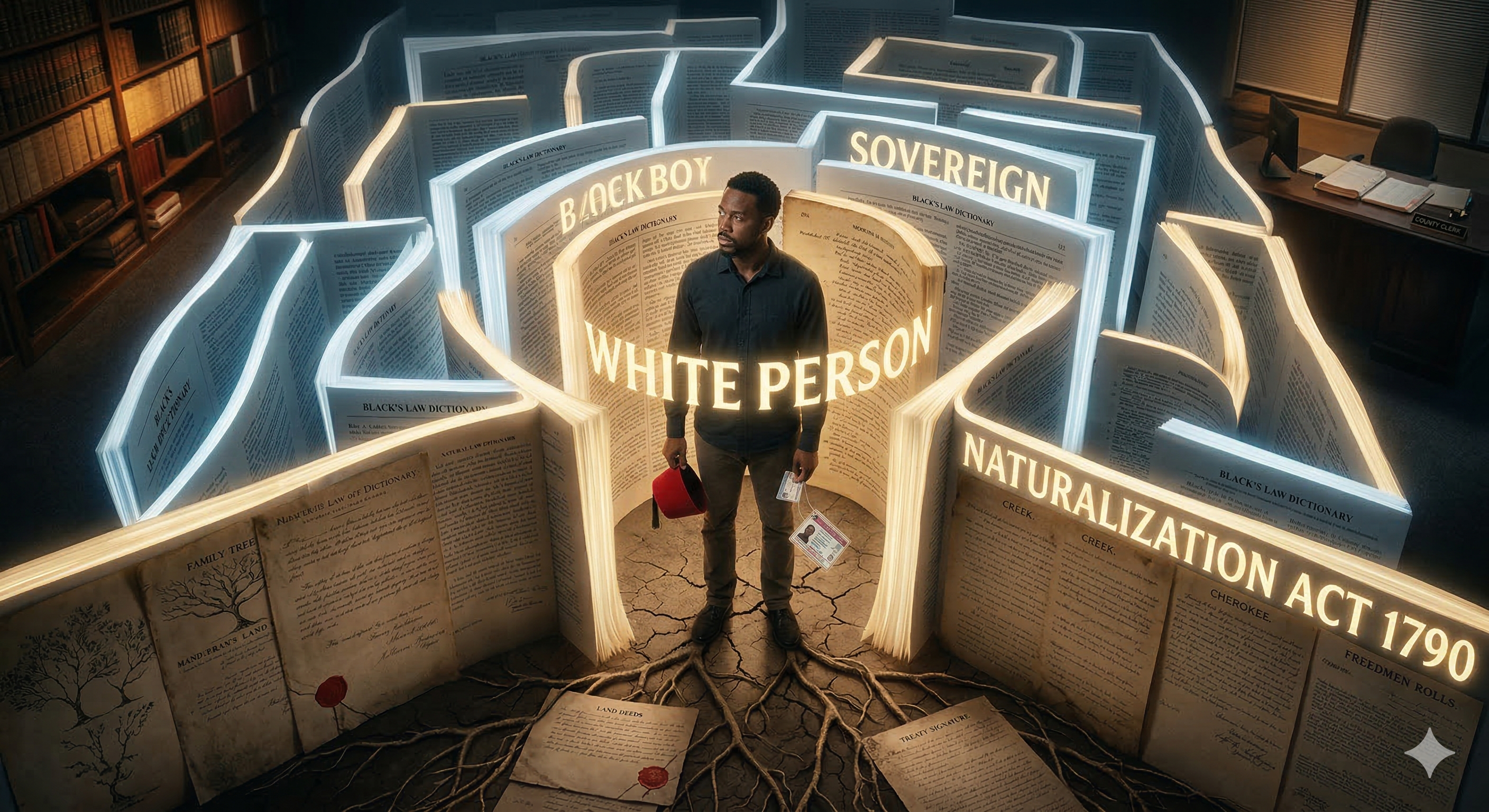
Somewhere in America right now, a man who has Cherokee, Muscogee, and Gullah ancestry — whose family name appears on the Dawes Roll, whose great-great-grandfather held a land allotment that was never legally transferred — is applying for a diversity grant.
The grant is for $15,000.
The land allotment his ancestor was assigned is worth, at current market rates, somewhere between $400,000 and $2 million depending on what's been built on it in the last 120 years.
He will probably get the grant. He will probably post about it. The algorithm will reward him with impressions. His follower count will tick up. A platform will invite him to speak on a panel about representation in his industry.
He will be included. He will not be compensated. He will not find his roll number.
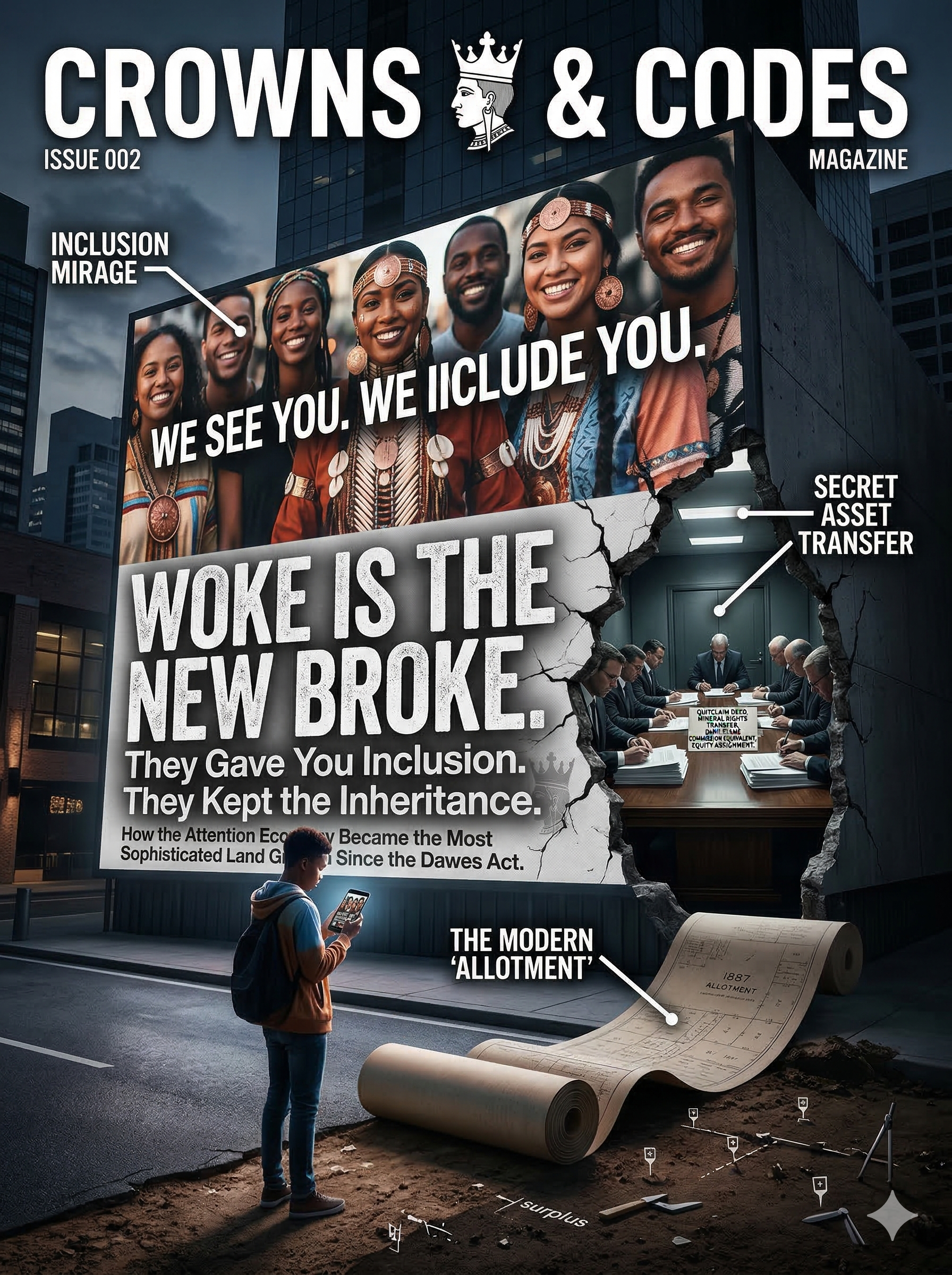
He traded the inheritance for the inclusion. And the system that offered him the trade knew exactly what it was buying.
This is woke. And woke is the new broke.
Part One: The Trade
To understand the trade, you have to understand what the attention economy actually is — not the romantic version where creators build audiences and audiences support creators, but the forensic accounting version.
The attention economy runs on one asset: your credibility with your own people.
Every person who built a following in the last fifteen years did it the same way. They found a community that was hungry for truth, for identity, for a narrative that matched their lived experience. They delivered that truth consistently. The community grew. The credibility compounded. The audience became an asset.
Then the platforms arrived with an offer. Not a cash offer. A structural offer. An algorithmic offer. The offer said: we will amplify you — but the content we amplify will be content that serves our classification system. Post about your pain. Post about your marginalization. Post about the systems that oppress you. Frame yourself as a victim of structures too large to fight. Keep your audience in a state of perpetual grievance with no actionable exit.
We will give you reach. We will give you grants. We will give you panels and partnerships and verified checkmarks. We will include you in every conversation about your own dispossession.
We will not give you the deed.
Part Two: The Dawes Comparison
The Dawes Commission arrived in Indian Territory in 1898 with a specific mandate: enumerate the population, assign categories, distribute allotments, and convert communal land into individual parcels small enough to be taxed, sold, or seized.
The genius of the Dawes system was not the seizure. The seizure was the outcome. The genius was the categorization — the creation of a classification hierarchy that made some people worth more than others, not based on their actual land claim or genealogy, but based on which roll the enroller decided to put their name on.
Cherokee by Blood: 110 acres. Cherokee Freedmen: 40 acres. Not enrolled: 0 acres. Land declared surplus.
The DEI economy runs the same algorithm.
The categories have been updated — "underrepresented minority," "BIPOC creator," "marginalized voice" — but the function is identical. The system creates a classification hierarchy. It assigns value based on category membership rather than sovereign claim. It distributes attention, grants, partnerships, and platform access in allotments calibrated to keep the recipient dependent on the system's continued approval.
A diversity grant is a 40-acre allotment. It is real. It is not nothing. But it is precisely calibrated to be enough to survive on and not enough to build sovereignty from.
The Freedman who received 40 acres in 1902 was not given nothing. He was given exactly enough to prevent him from making the larger claim — the one that would have required the system to acknowledge that his land rights ran deeper than the Freedmen roll, that his ancestry predated the categories being used to define him, that the allotment itself was a fraction of what the treaty had promised.
The creator who receives the diversity grant, the speaking engagement, the platform partnership — he is being given exactly enough to prevent him from making the larger claim.
Inclusion is the new 40 acres. The inheritance is still on the table. Nobody told you it was there.
Part Three: The Platform as Dawes Commission
When a creator builds an audience of 100,000 people who trust him to deliver truth about their identity, their history, and their rights — that audience is an asset. It has measurable economic value. It can be converted into memberships, products, services, events, and generational wealth. It is, in the language of the attention economy, owned land.
The platform's business model depends on that creator never converting his audience into owned land.
Because if the creator converts his audience into a membership — into a direct financial relationship that lives off the platform, outside the algorithm, beyond the reach of the terms of service — the platform loses. It loses the advertising revenue generated by that audience's attention. It loses the data generated by that audience's behavior. It loses the influence over what that audience believes.
The platform's solution is the same solution the Dawes Commission used: keep the land in a state where it can be used but never owned. Give the creator reach but not portability. Give him impressions but not email addresses. Give him viral moments but not recurring revenue. Give him a verified checkmark — the attention economy's equivalent of a roll number — that identifies him as a legitimate participant in the system without giving him any equity in the system itself.
A verified checkmark on a platform you don't own is not an asset. It is a permission slip. And permission slips get revoked.
Ask any creator who built a following on Vine. On MySpace. On the first iteration of Facebook organic reach before the algorithm changed in 2012. Ask the creators who were demonetized in 2017, shadow-banned in 2019, deplatformed in 2021.
The platform gave them reach. The platform kept the land.