Right now, in 2026, there are tens of thousands of Americans who qualify for Cherokee Nation citizenship — with land rights, treaty rights, and federal benefits attached — who have been told they are not Indian enough to enroll.
They are being told this by the same nation that enslaved their ancestors.
And here is the part that will keep you up tonight: the Cherokee weren't originally in the business of enslaving Africans. They were in the business of enslaving Indians.
Before the first cotton field, before the first plantation house went up in Georgia, the Cherokee ran a captive economy built entirely on Indigenous prisoners of war. Shawnee. Tuscarora. Creek. Yuchi. Taken in raids. Forced into servitude. Sometimes sold to European traders for guns and manufactured goods.
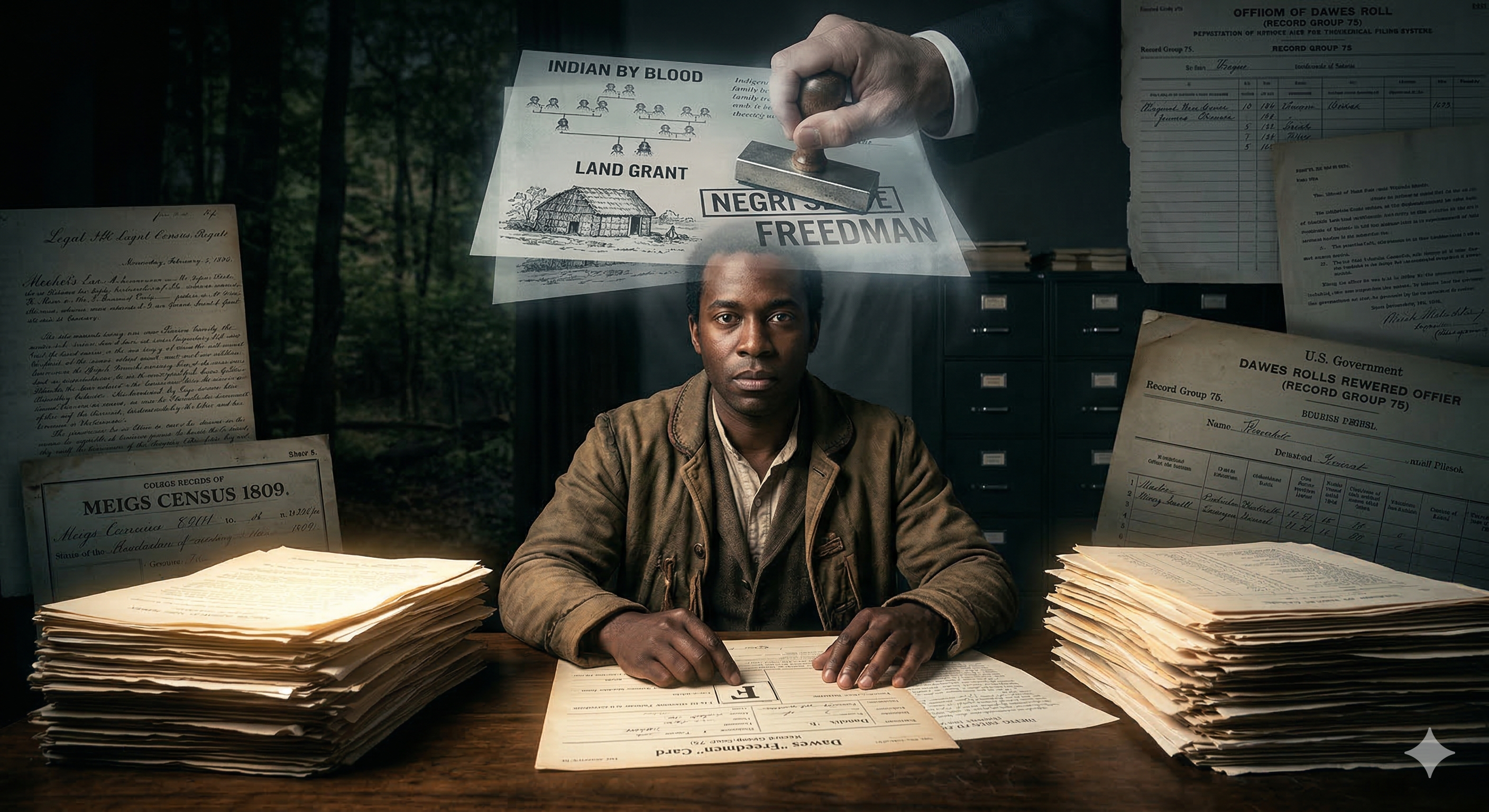
So when the records show up in 1809 listing 583 "Negro slaves" in the Cherokee Nation — the question no one is asking is: who decided they were Negro?
Part One: The Original System
The historical record on this is not contested. Before the plantation model arrived, Cherokee slavery was Indigenous slavery.
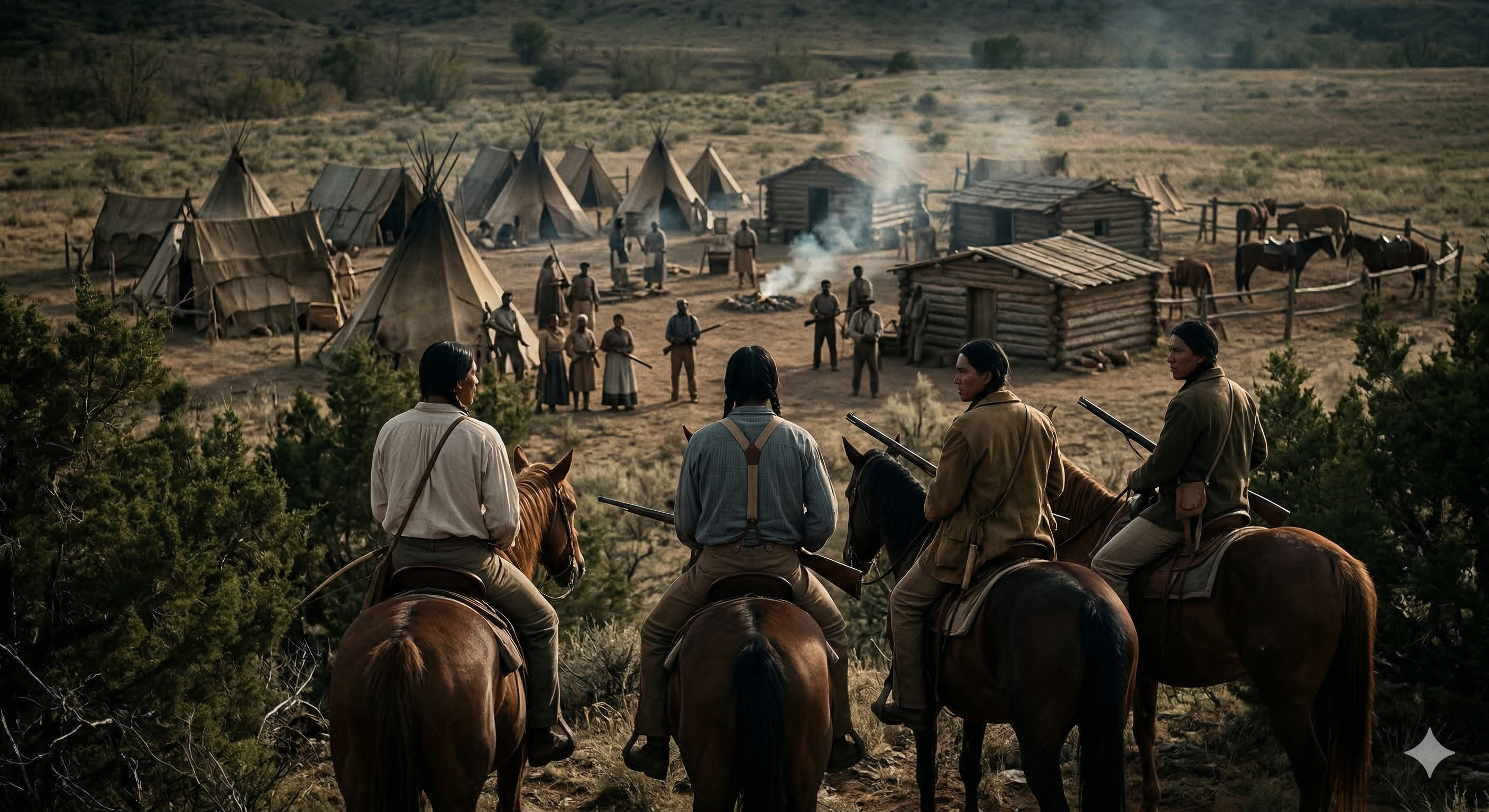
Captives were prisoners of war from rival nations. Their status was not always permanent — some were adopted into clans, some were ransomed, some were executed. But the core of the system was this: you were taken from your people by force, your identity was subordinated to your captor's, and your labor belonged to someone else.
That is the system that was already running when European colonists arrived and introduced something new: the legal category of "Negro."
The "Negro" category was not a description. It was a technology. It was a legal instrument designed to sort human beings into permanent, hereditary bondage. A Cherokee captive from the Shawnee Nation had a nation, a genealogy, a clan, a language, a territorial claim. A "Negro slave" had none of those things — by legal definition.
The question Crowns & Codes is putting on the table is this: What happened to the Indigenous captives already inside the Cherokee Nation when the "Negro slave" category arrived?
Part Two: The Reclassification Problem
Here is what the timeline looks like when you lay it flat:
Pre-1700s: Cherokee run a captive economy based on Indigenous prisoners of war. Captives come from dozens of surrounding nations — many of whom the Cherokee have been in conflict with for generations.
Mid-1700s: The colonial Indian slave trade is active. Cherokee are selling Indigenous captives to Europeans in exchange for firearms and goods. At the same time, European plantation owners are pushing the "Negro slave" category deeper into the Southeast.
1809: The first formal census of the Cherokee Nation records 583 "Negro slaves." These are the first people in the official record to carry that label inside Cherokee territory.
The gap nobody talks about: between the captive-based economy of the 1700s and the 1809 census listing nearly 600 "Negroes" — there is no documented mass importation of African slaves into Cherokee territory. There is no Cherokee equivalent of the transatlantic slave ship manifest. There is no auction record. There is no documented purchase chain connecting the Cherokee "slave" population to West African ports.
What there is — is an existing captive population of Indigenous people, already inside the Nation, already in servitude, who needed to be categorized inside the new legal framework being imposed by the U.S. government and surrounding slave states.
The simplest explanation for 583 "Negro slaves" appearing in a nation that ran an Indigenous captive economy is not that 583 Africans were imported.
It is that 583 Indigenous captives got their race changed on paper.
Part Three: The Statistical Record
Look at this census data and ask yourself whether these numbers make sense for an African slave population:
| Year | Source | Recorded "Negro Slaves" | Key Context |
|---|---|---|---|
| 1809 | Meigs Census | 583 | No documented importation chain from West Africa |
| 1824 | Tribal Records | 1,000+ | Population nearly doubled in 15 years — in a landlocked nation with no slave port |
| 1835 | Henderson Roll | 1,592 | 7.4% of Cherokee families listed as slaveholders |
| 1860 | Federal Census | 2,511–4,600 | Peak population — nearly tripled in 25 years with no documented purchase pipeline |
A population that nearly triples in 25 years, inside a landlocked nation, with no slave port, no auction house, no documented purchase pipeline from Southern markets.
Where did they come from?
The most documented answer is: they were already there. Indigenous captives, mixed-heritage families, people whose ancestry ran through the tribal nations of the Southeast — reclassified, generation by generation, into the "Negro" column.
The Cherokee's own legal codes tell this story if you read them carefully. In 1819–1820, the Cherokee Council passed "Slave Codes" that regulated the trade of enslaved Africans and prohibited them from owning property or horses. In 1824, a law made it illegal for Cherokee citizens to marry "negroes or mulattoes." The 1827 Constitution explicitly barred anyone of African descent from holding office.
But here is what those codes cannot explain: if this was an African slave population imported through standard Southern channels, why did the Cherokee need to legally define them as Negro? Why was the racial boundary requiring constant legal reinforcement?
You reinforce a boundary that is being crossed. You legislate a distinction that people are blurring.
The Cherokee were legislating against the blurring of a line between their Indigenous captive population and their Cherokee citizen population — because the people on either side of that line looked the same, spoke related languages, and had been living inside the same national territory for generations.