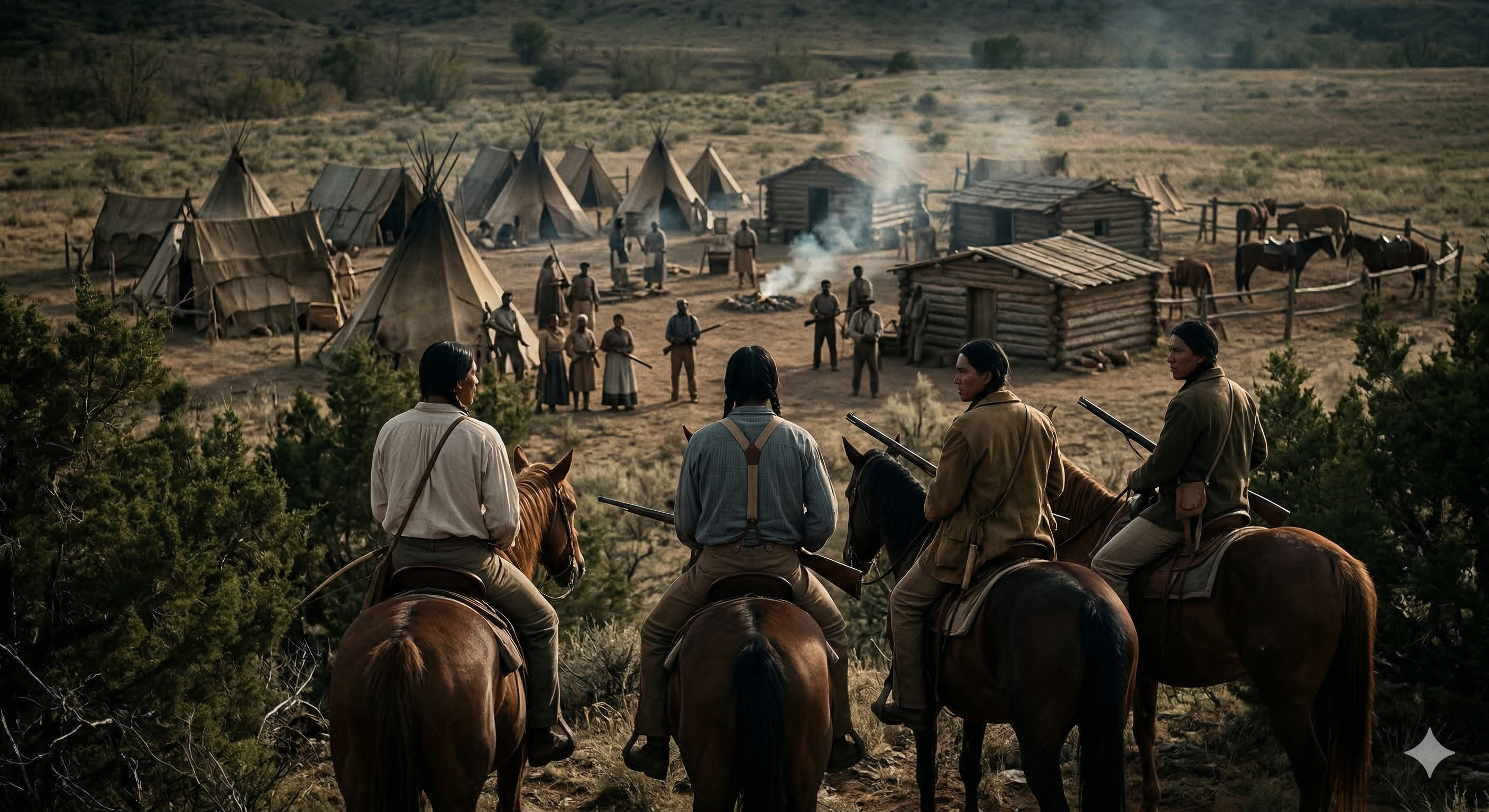
On June 23, 1865 — two full months after Robert E. Lee surrendered at Appomattox — a Cherokee general named Stand Watie rode into the field and laid down his arms.
He was the last Confederate general to surrender in the entire Civil War.
He commanded an army of 3,000 Cherokee soldiers. They had fought for four years across Indian Territory — burning Union supply lines, raiding federal depots, holding ground that every military analyst said couldn't be held. Stand Watie's 1st Cherokee Mounted Rifles were not a sideshow. They were a sovereign military force fighting a war on behalf of their nation.
One year after Stand Watie surrendered, the U.S. government sat the Cherokee Nation down and made them sign a new treaty.
When that treaty was finished, thousands of the men who had just finished fighting in Stand Watie's army had a new legal classification. They were no longer soldiers. They were no longer Indian. They were former slaves.
And their land — guaranteed by every treaty signed since 1785 — was now "surplus."
Part One: Who Actually Fought
Before we get to the treaty, let's establish who was in that army — because the official history has been remarkably incurious about this question.
The Five Civilized Tribes signed formal treaties of alliance with the Confederate States of America in 1861. All five. The Cherokee, the Choctaw, the Chickasaw, the Creek, and the Seminole each negotiated their own terms, their own regiments, and their own military command structure.
| Nation | Estimated Soldiers | Regiment |
|---|---|---|
| Cherokee | ~3,000 | 1st & 2nd Cherokee Mounted Rifles |
| Choctaw | ~1,500 | 1st Choctaw & Chickasaw Mounted Rifles |
| Chickasaw | ~1,000 | Combined with Choctaw units |
| Creek | ~1,500 | 1st & 2nd Creek Volunteer Regiments |
| Seminole | ~400 | 1st Seminole Cavalry Battalion |
Total: somewhere between 7,000 and 9,000 Indigenous soldiers fighting under Confederate command in Indian Territory.
Now here is the question the history books skip entirely: Who were the "enslaved people" in the Cherokee Nation that the 1866 Treaty was written to liberate?
The official story says they were African slaves. But recall what we established in the previous investigation: the foundational slave class in the Cherokee Nation was not African. It was Indigenous. And the population nearly tripled in 25 years with no documented importation chain from West Africa.
Many of the men who had just finished fighting as Confederate Indian soldiers — men with military service records, men who had bled for their nation — were reclassified one more time when that treaty was signed.
Part Two: Read the Actual Treaty Language
The Reconstruction Treaties of 1866 were not liberation documents. Read the actual text.
Article 9 of the 1866 Cherokee Treaty states that all "freedmen who have been liberated by voluntary act of their former owners or by law... and their descendants, shall have all the rights of native Cherokees."
On the surface this sounds like inclusion. Rights of native Cherokees. Full citizenship.
Here is what it actually did.
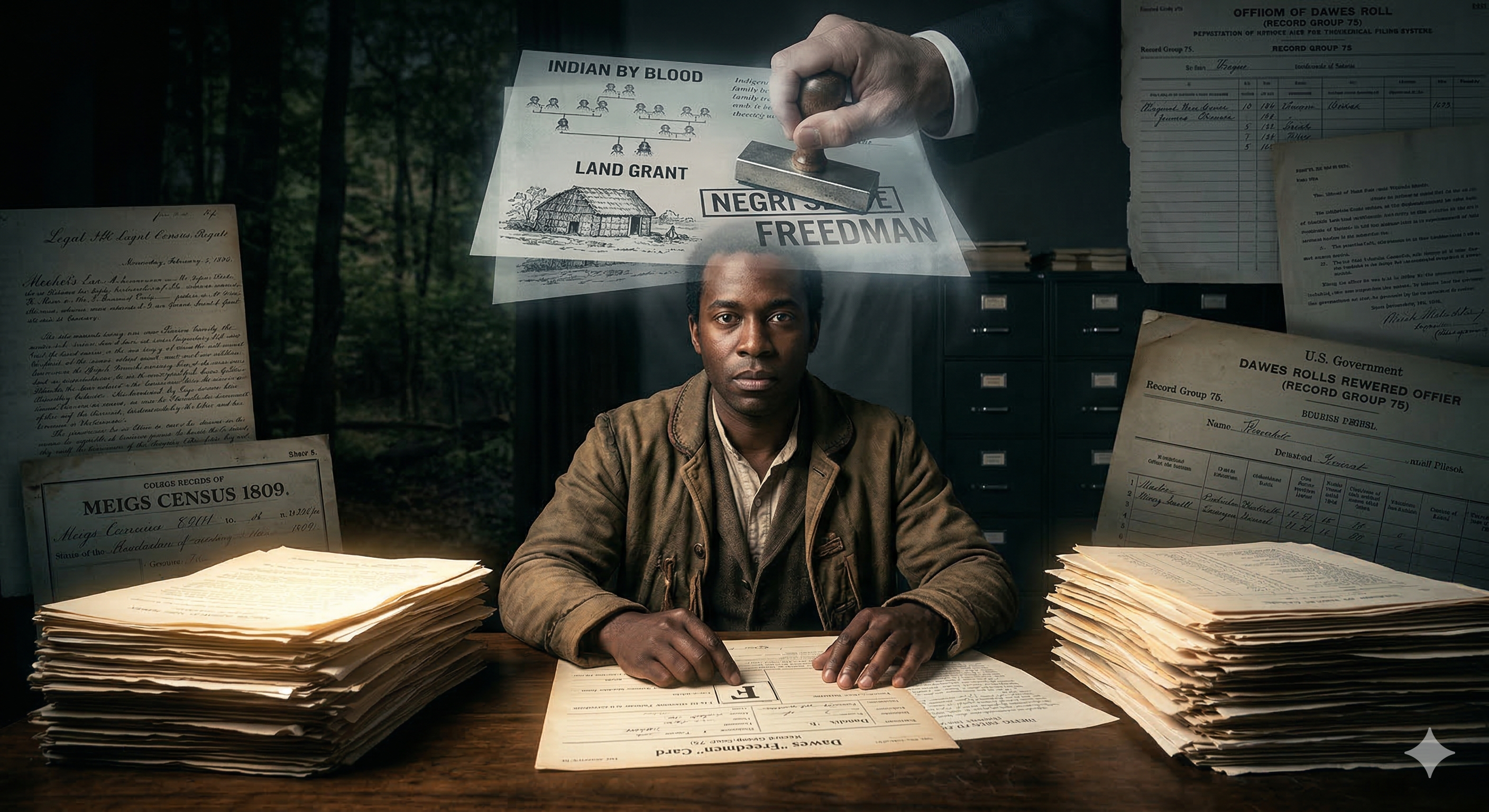
It created a separate enrollment category. "Freedmen" were not enrolled as "Cherokee by Blood." They were enrolled as "Cherokee Freedmen." Same nation, different roll, different land allotment, different rights in every practical application that followed.
The Dawes Commission — which finalized tribal rolls between 1898 and 1914 — maintained four separate Cherokee rolls: Cherokee by Blood, Cherokee by Intermarriage, Delaware Cherokee, and Cherokee Freedmen.
A person on the "Cherokee by Blood" roll received an average land allotment of 110 acres. A person on the "Cherokee Freedmen" roll received a maximum of 40 acres — in many cases less.
If a man who had been fighting as a Cherokee soldier for four years was reclassified as a Freedman instead of enrolled as Cherokee by Blood — he lost approximately 70 acres of land by legal definition.
Multiply that by thousands of men. Multiply that by the oil and mineral rights that land contained. That is the financial erasure.
Part Three: The Orphan Comparison
Here is the data point that makes this impossible to explain as anything other than deliberate.
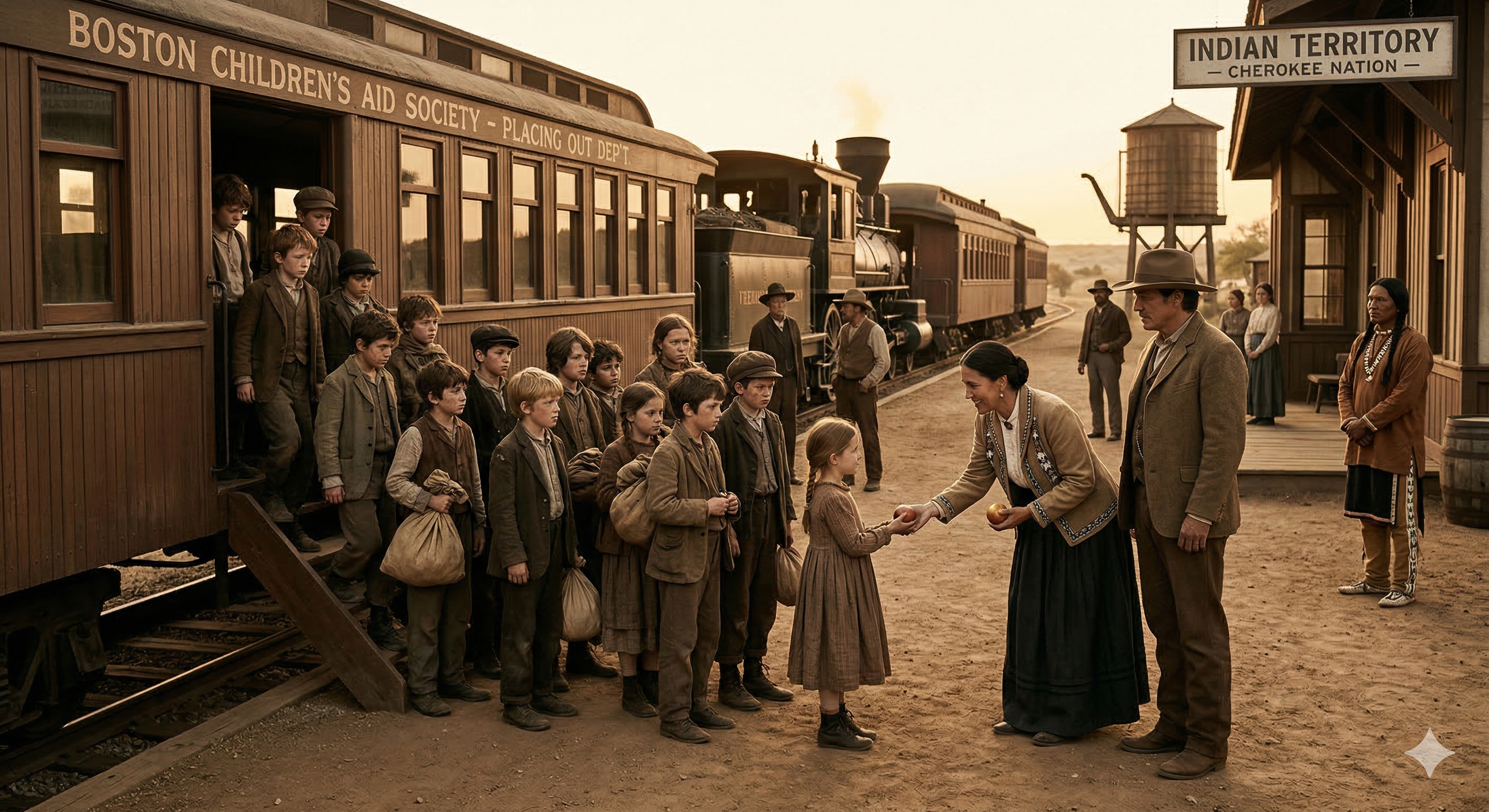
While Freedmen were being capped at 40-acre allotments, the federal system was simultaneously protecting a completely different class of displaced persons — white orphan children placed in Indian Territory through the Orphan Train movement. Children with no Indian ancestry, no tribal lineage, no genealogical connection to the land.
Their entitlement as wards of the court: 80 acres.
A white orphan from New York City with zero connection to the Cherokee Nation was legally entitled to double the land of a Cherokee Freedman whose family had lived in the Nation for generations.
The Cherokee Nation, during this same period, was expanding the Cherokee Orphan Asylum to house hundreds of children — funded by tribal resources, on tribal land. Freedmen children — children of men who had just fought a four-year war as Cherokee soldiers — were denied access to these institutions. They were not "Indian enough" for the tribal orphan system and not "white enough" for the legal protections being extended to Orphan Train children.
They were the children of soldiers with nowhere to go and no legal category that protected them.
The Cherokee Nation lost 28% of its total population between 1861 and 1865. The orphan crisis following the war was catastrophic. And the people most directly responsible for creating that crisis — the soldiers who had fought and died — had their children shut out of the system built to care for the survivors.
The weapon was not a gun. It was a roll number. It was a pen stroke that moved a man's name from one column to another.
And the land those columns controlled built the state of Oklahoma.