The document exists. It is not a theory. It is not folklore. It is sitting in the Thurloe State Papers — the official archive of Oliver Cromwell's government — and it reads exactly the way you think it reads.
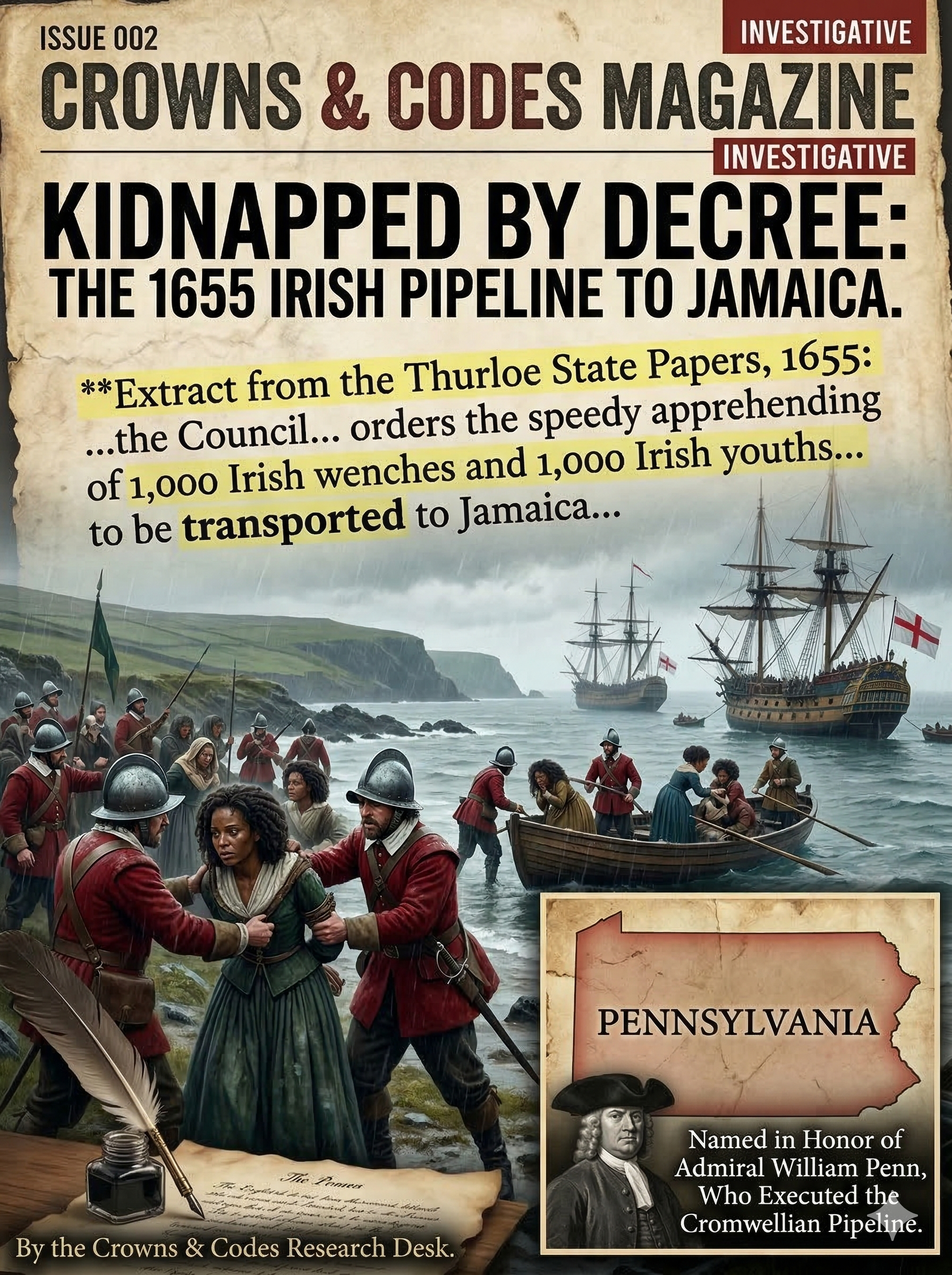
In 1655, the Council of State of the English Commonwealth issued a formal decree ordering the seizure of "1,000 Irish wenches" and "1,000 Irish youths" from the province of Munster to be transported to Jamaica.
Not recruited. Not offered passage. Not given contracts.
Seized.
The man who made it logistically possible — who captured Jamaica in the first place, who secured the harbor, who cleared the island for British colonial use — was Admiral William Penn.
His son, William Penn Jr., founded Pennsylvania.
There is a state in America named after the family that ran the pipeline.
Part One: Why Ireland First
To understand what Penn did in Jamaica, you have to understand what he did in Ireland first — because they are the same operation, separated by seven years and three thousand miles of ocean.
In 1644, Oliver Cromwell's New Model Army was dismantling the English monarchy. Ireland had not surrendered. The Irish Confederate Catholics were holding the island as a Royalist stronghold, and the exiled Prince Rupert was operating a Royalist fleet out of Irish ports. As long as Ireland held, the Commonwealth was fighting a war on two fronts with an open western coast.
Cromwell's solution was Admiral William Penn.
Penn was given command of the Irish Squadron with a specific mission: blockade the southern Irish ports. Kinsale. Waterford. Cork. Seal the sea lanes. Prevent Royalist reinforcements from reaching the Irish mainland. Starve the Confederate Irish of supply and support until Cromwell's land forces could finish the job.
In 1648, Penn executed the central operation of the Irish campaign — he cornered Prince Rupert's fleet off the coast of Kinsale and forced it out of Irish waters permanently. With the Royalist navy neutralized, Cromwell's army moved freely. The Irish Confederacy collapsed. By 1652, Ireland was under full Commonwealth military occupation.
The land was then redistributed. Cromwell's investors — men called "Adventurers" who had funded the conquest on the promise of Irish land grants — received their payment in confiscated Irish territory. The native Irish of Munster, Ulster, and Leinster were dispossessed, displaced, and in Cromwell's own documented phrase, given a choice: "To Hell or to Connacht."
Penn had cleared the sea. Cromwell had cleared the land. But the people were still there — hundreds of thousands of dispossessed Irish now classified by the Commonwealth government as "superfluous" and "dangerous."
They needed somewhere to go. Penn was about to build that somewhere.
Part Two: The Western Design
In 1654, Cromwell launched what his government called the "Western Design" — a secret military operation to break the Spanish monopoly in the Caribbean. The command was split: Admiral William Penn commanding the naval forces, General Robert Venables commanding the land troops.
The original target was Hispaniola — the crown jewel of Spanish Caribbean territory. The assault was a catastrophe. Penn's fleet of 38 ships and approximately 8,000 soldiers landed and was repelled within days. The Spanish defense was disciplined. The English troops were diseased, underfed, and poorly coordinated. Venables and Penn despised each other and could not agree on basic tactical decisions.
They retreated to their ships having accomplished nothing.
Now they had a problem. Cromwell had personally authorized and funded the Western Design. Returning to England empty-handed was not a survivable career decision. Penn and Venables needed a trophy.
They looked west. Ninety miles from Hispaniola sat a smaller island. Lightly defended. A Spanish backwater. A harbor that the Spanish had never properly fortified.
Jamaica.
On May 10, 1655, Penn's fleet entered what is now Kingston Harbour. The Spanish governor, Juan Ramírez de Arellano, had fewer than 500 armed men. He looked out at 38 English warships and made the only rational decision available to him. He did not fight. He negotiated a symbolic surrender while secretly ordering every Spanish settler to take their cattle, their valuables, and their families into the Blue Mountains in the island's interior.
Penn secured the harbor. Venables raised the English flag. They declared Jamaica an English possession. Then both men got back on their ships and sailed home to England.
They left behind a garrison of approximately 3,000 soldiers — sick, underfed, on a tropical island they didn't understand, fighting a decade-long guerrilla war against the Spanish settlers and their formerly enslaved allies who came down from the Blue Mountains to ambush English foraging parties at night. Those fighters — who became the Jamaican Maroons — held sections of the Blue Mountains against English military forces for the next eighty years.
Cromwell was furious. Both Penn and Venables were briefly imprisoned in the Tower of London on their return. Penn was released, retired from active command, and spent his remaining years managing the consequences of the Western Design.
But Jamaica was English now. And an English colony needs people.
Part Three: The Decree
The island Penn had captured was, from the Commonwealth's perspective, essentially empty. The Spanish settlers were gone. The Maroons controlled the mountains. The English garrison was dying of disease faster than reinforcements could arrive.
The Council of State needed a labor population. They needed people who were numerous, already subjugated, with no political allies, no legal standing, and no ability to resist transportation.
They looked at Munster.
The decree issued in 1655 — documented in the Thurloe State Papers, the official correspondence archive of Secretary of State John Thurloe — ordered the seizure of 1,000 Irish women and 1,000 Irish youths from the province of Munster for transportation to Jamaica.
The language used was "indentured servitude." The reality documented in the same archive was forced seizure. There were no contracts. There were no terms of release. Many of the people transported had no documentation of any kind — which was, by design, the point. A person with no papers has no legal identity. A person with no legal identity cannot make a claim.
| Phase | Location | Penn's Action | Strategic Goal |
|---|---|---|---|
| 1644–1652 | Kinsale, Ireland | Naval blockade — sealed southern ports | Eliminate Royalist naval threat, enable Cromwellian conquest |
| May 1655 | Jamaica | Amphibious assault on Spanish colony | Seize Caribbean territory for the Republic |
| 1655–1660 | Munster to Jamaica | Facilitated forced transportation | Populate new colony with subjugated labor |
Between 1655 and 1660, historical estimates place the total number of Irish people transported to the West Indies — primarily Jamaica and Barbados — at between 10,000 and 12,000. The majority came from Munster. The mortality rate on Jamaican plantations in this period was documented at nearly 50% within the first three years of arrival.
The Commonwealth government had solved its "superfluous Irish" problem and populated its new colony in a single operation. The architect of the Irish naval campaign and the Jamaican conquest was the same man.
Penn had blockaded the ports that starved Munster into submission. Penn had captured the island that needed populating. The pipeline ran through him from beginning to end.