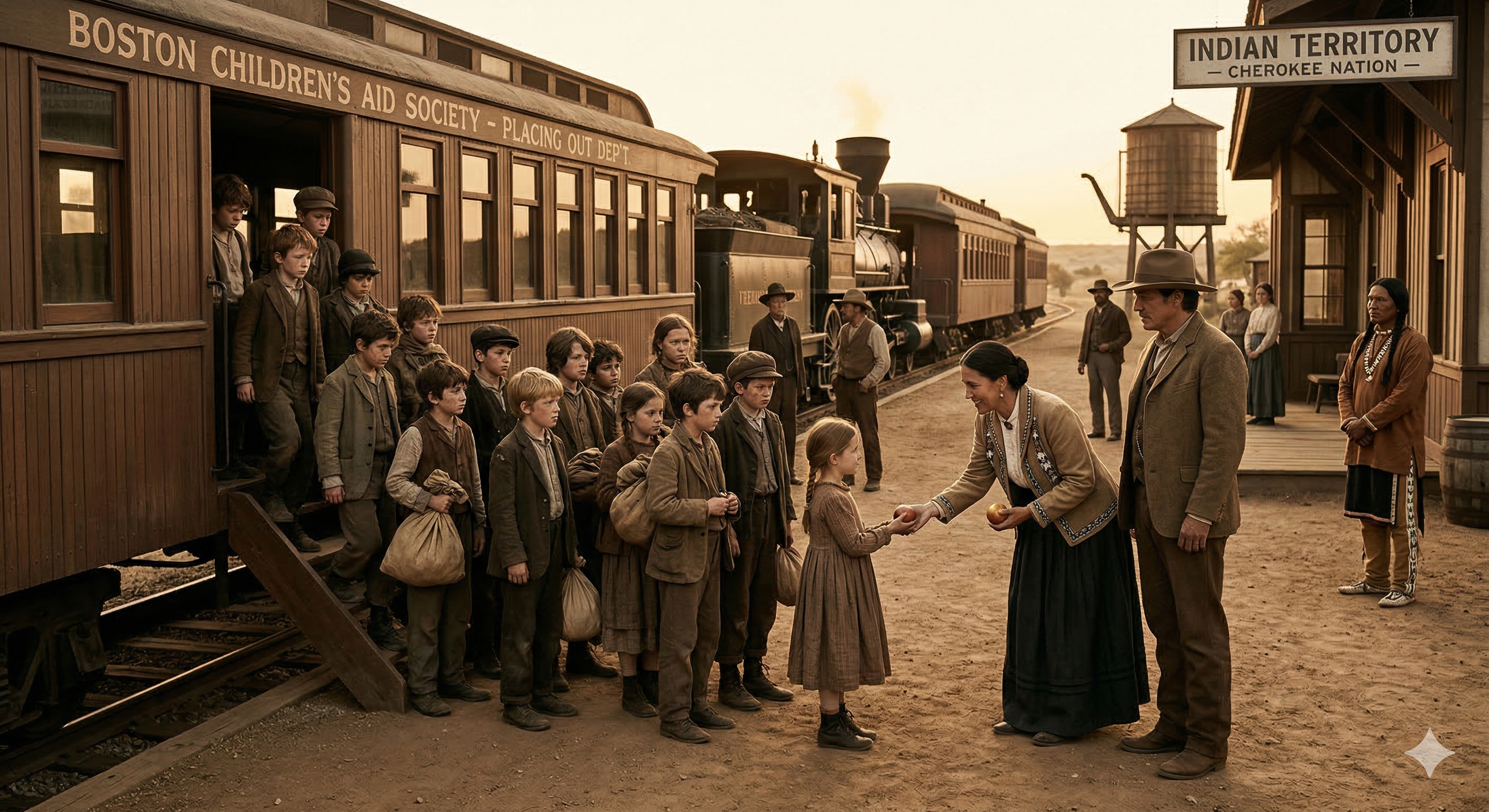
Between 1854 and 1929, approximately 200,000 children were loaded onto trains in New York City and Boston and shipped west.
They were Irish. German. Italian. The children of immigrants who had died of disease, poverty, and the ordinary brutality of industrial-era urban life. They were placed on platforms in small towns across the Midwest and the territories and displayed to crowds of strangers who could take them home if they liked what they saw.
The program was called the Orphan Train Movement. Its architects called it child rescue.
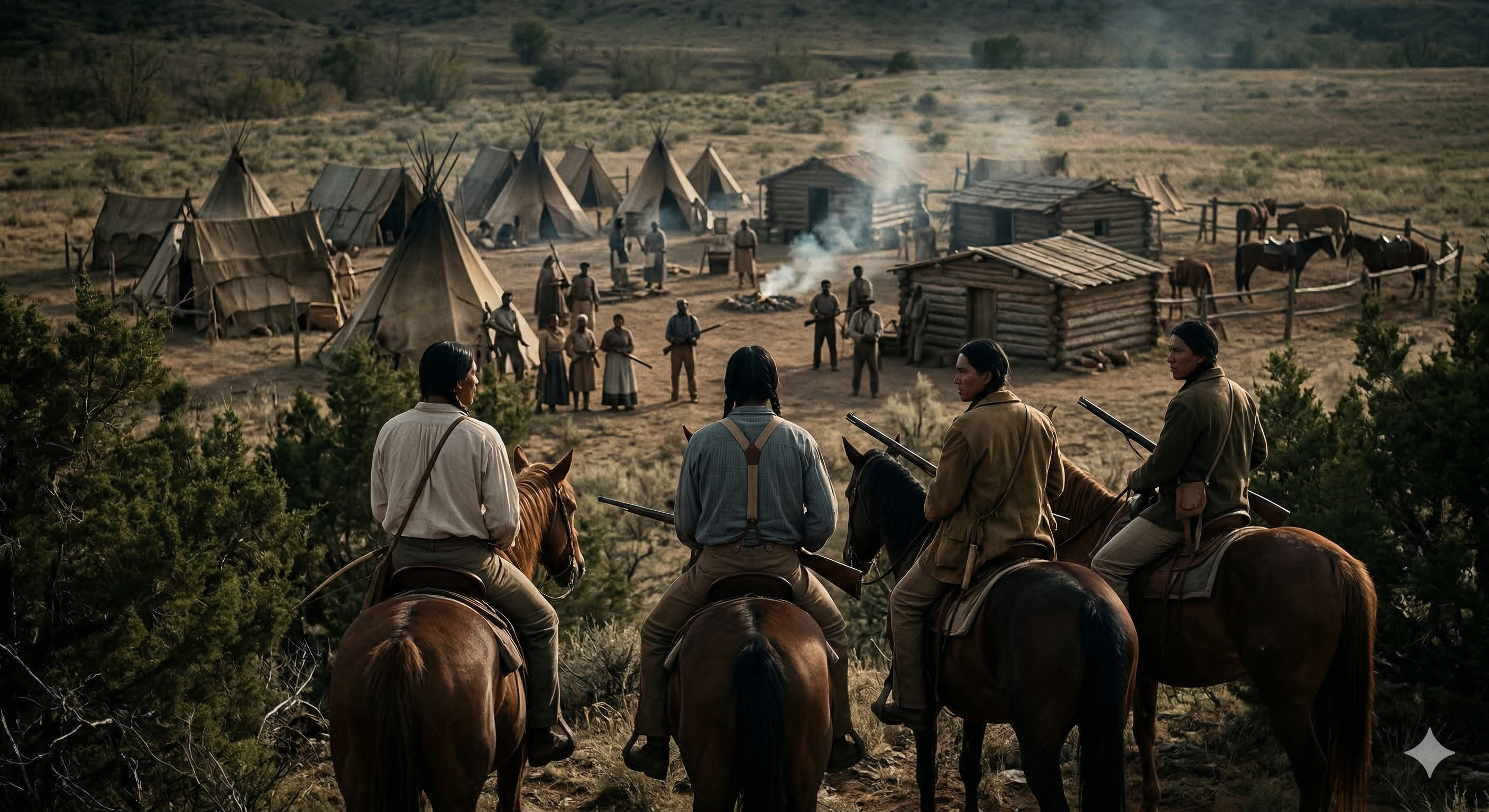
Some of those children ended up in Indian Territory. Some were taken in by wealthy Cherokee, Choctaw, and Chickasaw families — the planter class of the Five Civilized Tribes, the mixed-heritage elite who owned large estates. These children grew up speaking Cherokee. Speaking Choctaw. Learning the ceremonial calendar, the agricultural traditions, the kinship systems, the land boundaries.
They became, in every cultural sense, Indian.
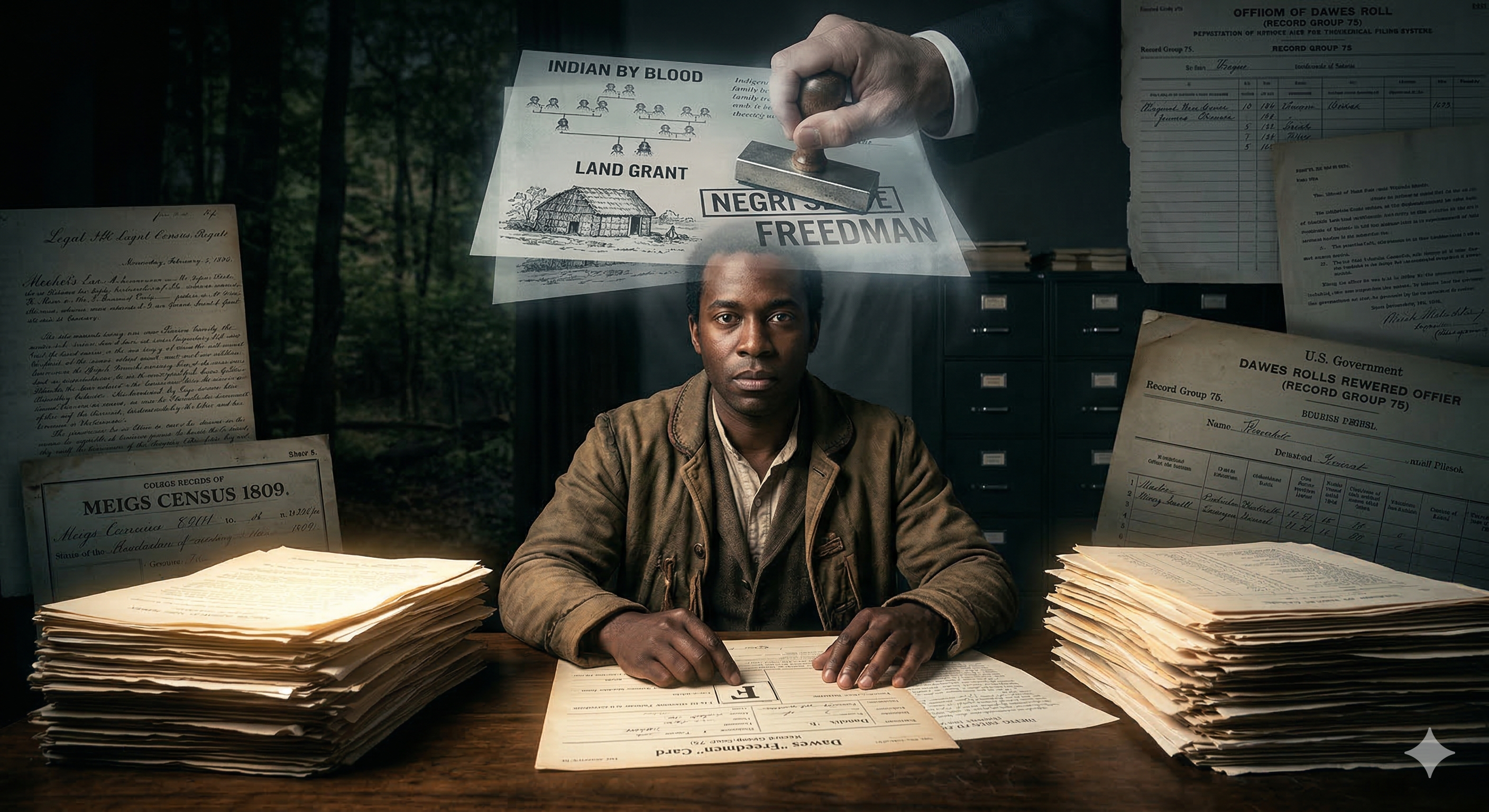
And when the Dawes Commission arrived between 1898 and 1914 to finalize who was entitled to tribal land allotments — a portion of those European children, formally adopted into high-ranking tribal families, appeared on the Dawes Roll. Not on the Freedmen roll. Not on the Intermarried White roll.
On the Blood roll.
The same roll that capped Cherokee Freedmen — people with documented generational ties to the Nation — at 40 acres.
Nobody sends 200,000 children into a war zone by accident.
The train was the delivery system. The Dawes Roll was the enrollment mechanism. And the product was a legally documented, European-looking Indigenous landowning class that held tribal land titles without triggering the racial alarm systems of the surrounding white settler society.
This was not charity. This was architecture.
Part One: The War Zone Nobody Mentions
The Orphan Train Movement began in 1854. Here is what 1854 looked like in Indian Territory.
The Five Civilized Tribes were in the final decade before the Civil War — a period of intense internal political conflict between the mixed-heritage planter elite and the traditional full-blood populations within each nation. The removal of the 1830s had displaced over 60,000 people from the Southeastern United States at the cost of thousands of lives. The nations were rebuilding their governments and their population bases in territory the U.S. government was already planning to open to white settlement.
Seven years after the Orphan Train began, the Civil War broke out. Indian Territory became one of the most contested military landscapes of the entire conflict. The Five Civilized Tribes split — some factions allied with the Confederacy, some with the Union — and fought a brutal internal civil war on top of the larger national conflict. The Cherokee Nation lost 28% of its total population between 1861 and 1865.
The Orphan Train continued operating through all of it.
Children were still being shipped into Indian Territory during active military conflict. During a period when the U.S. government could not guarantee the safety of its own soldiers in the region, it was placing children from New York City with tribal families inside that same region.
No legitimate child welfare operation places children in an active war zone.
The placement was intentional. The destination was intentional. The families receiving the children were not random. They were the high-ranking, politically connected, mixed-heritage elite of the Five Civilized Tribes — the families with enough wealth, enough stability, and enough legal standing to absorb a child into their household and, eventually, into their tribal citizenship rolls.
Part Two: The Government's Fingerprints
Here is the detail that removes all remaining ambiguity about whether the Orphan Train was a private charitable operation that the government simply permitted.
The U.S. government guarded the trains.
Federal soldiers and U.S. marshals provided security for Orphan Train shipments moving into Indian Territory. The same government that was actively negotiating, enforcing, and in many cases violating treaties with the Five Civilized Tribes was simultaneously providing armed escort for trainloads of European children being delivered into those same nations.
The government also housed the children in transit. Federal facilities — including military posts and government-administered holding stations in the territories — were used to stage and process children before their placement with tribal families.
The U.S. government does not deploy soldiers to protect private charity shipments.
Federal military escort is reserved for operations the government has a direct interest in completing successfully. The government had soldiers guarding these trains because the trains were delivering something the government needed delivered — not to the Midwest farm families the history books remember, but to the specific tribal households in Indian Territory that could absorb European children into the tribal citizenship structure.
The Children's Aid Society provided the paperwork. The New York Foundling Hospital provided the children. The U.S. government provided the guns, the housing, and the guarantee of safe delivery.
That is not a charity. That is a federal program with a private face.
Part Three: The Dawes Commission's Decision
The Dawes Commission was the federal body tasked with converting the Five Civilized Tribes from communally held national land to individually allotted parcels. To do this, they had to enumerate every person entitled to an allotment. They created four Cherokee rolls: Cherokee by Blood, Cherokee by Intermarriage, Delaware Cherokee, and Cherokee Freedmen.
The white orphan who had grown up speaking Cherokee, working Cherokee land, living inside the Cherokee Nation for twenty years — had one realistic path to enrollment: formal adoption into a high-ranking Cherokee family, recognized by the Cherokee National Council, generating a paper trail that said Cherokee citizen by the time the Dawes enroller arrived.
| Category | Basis for Enrollment | Land Allotment |
|---|---|---|
| Cherokee by Blood | Documented biological Cherokee ancestry | 110 acres (average) |
| Cherokee Freedmen | 1866 Treaty citizenship — formerly enslaved | 40 acres (maximum) |
| Orphan Ward (federal court) | Minor without parents — ward of the court | 80 acres |
| European orphan adopted by high-ranking Cherokee family | Formal tribal adoption — documented citizenship | Enrolled as Blood — 110 acres |
A white orphan from New York City with zero Cherokee blood, zero Cherokee genealogy, and zero connection to the land before the train dropped him at a platform in Indian Territory — received double the land of a Cherokee Freedman whose family had been on that land for generations.
This is not an anomaly. This is the system working exactly as designed.
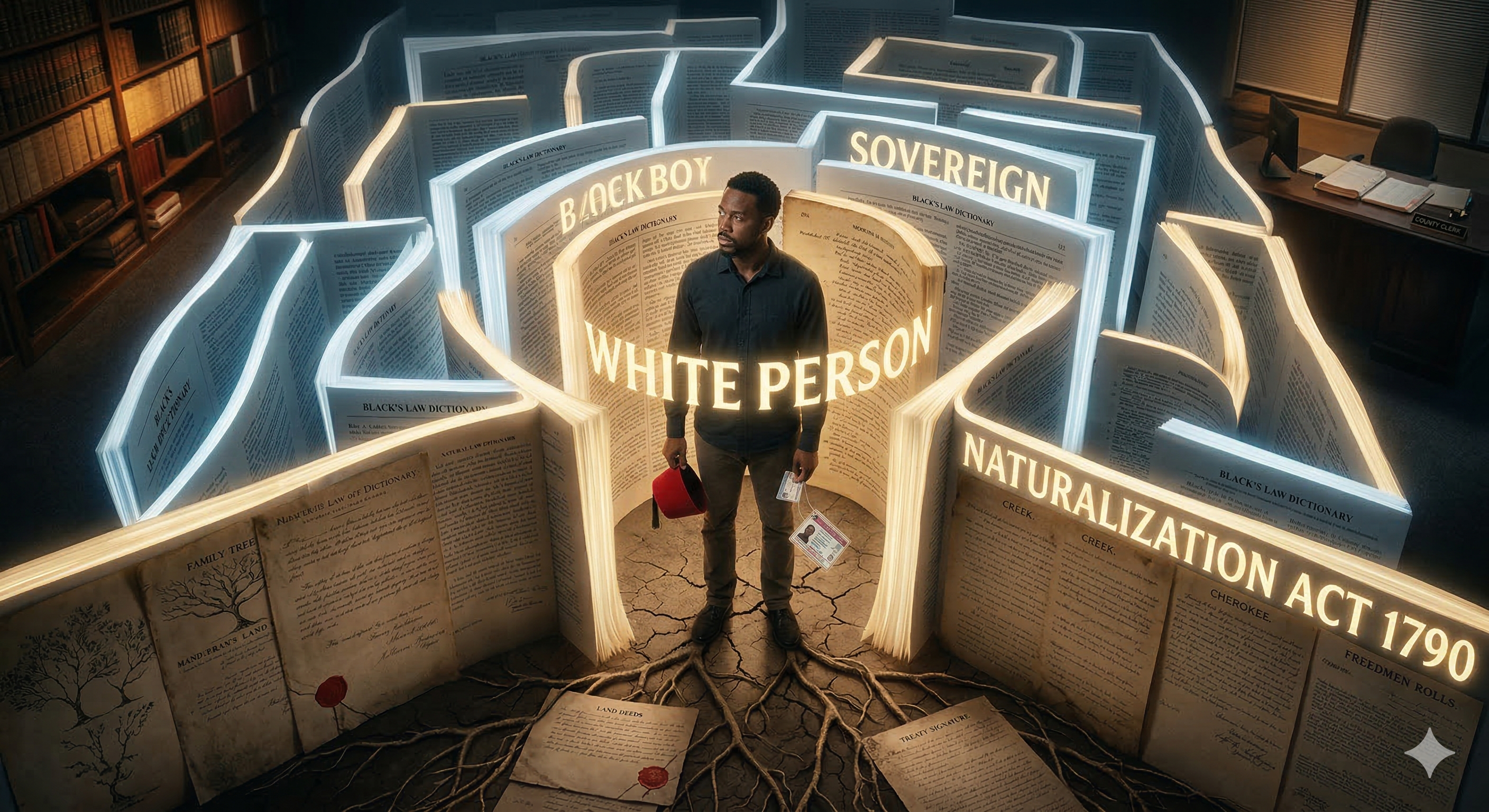
The Dawes Commission's own field notes acknowledge cases where racial categorization was contested — where families presented documentation of tribal citizenship but whose appearance raised questions. The Commission's resolution of these disputes was not consistent. The determining factor was not always the documentation. It was frequently what the enroller saw when he looked up from the paperwork.
A European-looking child, formally adopted into a high-ranking Cherokee family thirty years earlier, presenting tribal citizenship documents — was enrolled as Cherokee by Blood.
A dark-complexioned family with generational ties to the Nation, presenting the same quality of documentation — was enrolled as Cherokee Freedmen.
Same Commission. Same standards. Same rolls. Different outcomes based on what the enroller saw.
The orphan train had delivered European phenotypes into the tribal citizenship system. The Dawes Commission formalized those phenotypes as the standard of authentic Indigenous identity. The result was a By Blood roll that over-represented European appearance and under-represented the actual biological descendants of the Southeastern Indigenous nations.
That roll is still the basis for Cherokee Nation citizenship determinations today.