You have seen it happen in real life.
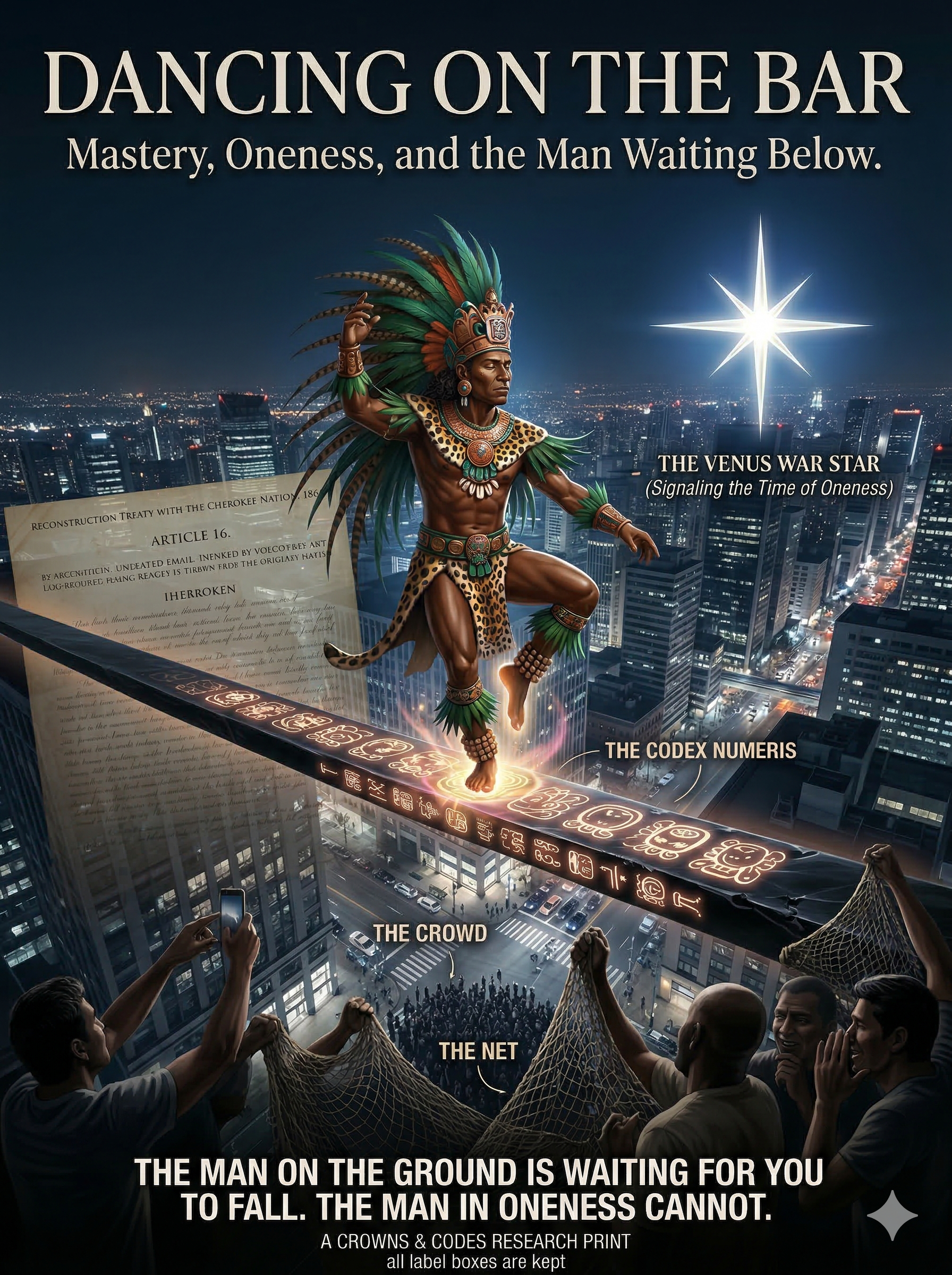
Someone climbs up on the bar. Maybe it's a table. Maybe it's a ledge. It doesn't matter. The point is the elevation — the deliberate choice to stand somewhere that everyone else in the room has decided is too risky, too unstable, too exposed.
The room holds its breath. Half of them are hoping for the fall. Not because they hate the person on the bar — but because the fall would confirm what they already believe: that elevation is dangerous, that standing above the crowd invites disaster, that the safe place is down here on the ground with everyone else.
Then the music plays. And the person on the bar starts to move.
And they don't fall.
Not because they got lucky. Not because the bar was sturdier than it looked. But because a person in full resonance with who they are does not operate by the same physics as a person who is performing for the room.
That is the 7D Reality. And it does not require the room's permission to exist.
Part One: The Difference Between the Source and the Signal
There are two classes of people operating in the attention economy right now.
The first class is chasing the signal. They watch what is trending, identify what the algorithm is rewarding, reverse-engineer the format, and produce content calibrated to catch the wave that someone else started. They are fast. They are prolific. They are, in the language of the platform, "relevant."
They are also completely replaceable.
Because a signal with no source is just noise with good timing. The moment the trend shifts — and it always shifts — the signal-chaser has to start over. They have no anchor. They have no center. They have nothing that belongs only to them, nothing that cannot be copied, nothing that the next person cannot replicate within 48 hours of seeing it work.
The second class is the source.
The source does not chase trends. The source generates them — not by calculating what the market wants and delivering it, but by operating so completely from their own knowing that the market eventually has to come to where they already are.
This is not a motivational concept. It is an observable pattern in every creative, spiritual, and economic domain worth studying. Every trend you have ever seen started as someone's private conviction. It started as the thing one person was doing before it was popular, before it was validated, before the platform rewarded it. At the moment of origination it looked eccentric at best and delusional at worst.
Then the room started to catch up.
The source did not move. The room moved.
That is the 7D distinction. Not the loudest voice. Not the most followers. Not the best production quality. The deepest root. The most unshakeable knowing. The clearest understanding of why you were sent here.
Part Two: The Physics of Oneness
The person on the bar is not defying gravity. They are operating in a different relationship to it.
The fearful person on the bar is calculating. They are thinking about the height, the width of the surface, the distance to the floor, the audience watching, the probability of humiliation. Every calculation pulls attention away from the body and into the mind. Every calculation introduces a micro-tension into the muscles that makes the exact outcome they fear more likely.
The aligned person on the bar is not calculating. They are present. Their attention is not distributed across fifteen possible futures — it is entirely in the now, in the movement, in the music, in the moment. That totality of presence is what people looking from the outside call "flow state" and what the spiritual tradition calls oneness.
You cannot fall out of oneness. Not because oneness makes you physically invincible — but because the thing that causes falls is the division of attention, the anticipation of failure, the negotiation between what you are doing and what you are afraid might happen.
A person in oneness has no such division.
The audience watches and waits for the fall because they are measuring the person on the bar by the standards that govern their own experience — and in their experience, that height is dangerous. They are not wrong about their own experience. They are wrong about the person they are watching.
You are not tripping. You are showing them something they do not yet have the eyes to see.
Part Three: Apex Predators Don't Sleep With One Eye Open
There is a specific kind of exhaustion that comes from living in a state of constant vigilance without sovereignty.
The person who is not rooted in their purpose — who has not done the work of knowing who they are, why they are here, and what belongs to them — cannot fully rest. There is always something to protect that they are not sure they can hold. There is always someone gaining on them. There is always a trend they might be missing, a competitor they need to monitor, a position they need to defend.
They sleep with one eye open.
The apex predator does not sleep with one eye open. Not because the world is without threat — but because the apex predator's position in the ecosystem is not based on being faster than everyone else at all times. It is based on being what they are. The jaguar does not hustle to be the jaguar. The mountain lion does not perform mountain lion content to maintain its status in the food chain.
It simply is what it is. And everything else in the ecosystem organizes itself accordingly.
This is the Priest-King model at its most fundamental. Not the loudest. Not the most active. Not the most visible. The most rooted. The one whose position is not contingent on anyone else's recognition because it derives from something that recognition cannot grant and cannot revoke.
The sovereign does not chase. The sovereign does not explain. The sovereign does not compete with people who have not yet arrived at the level of understanding required to be a genuine competitor.
The question asked of those who present themselves as threats — who are you? — is not rhetorical. It is a genuine inquiry. Because the Priest-King operates in a space specific enough that the answer to "who are you" will immediately reveal whether a real conversation is possible.
Most of the time, the answer reveals that it is not.
That is not arrogance. That is discernment. And discernment is a sovereignty tool, not a personality flaw.