In 1054 CE, a star exploded.
The explosion was so massive that it was visible in daylight for 23 consecutive days. At night it cast shadows. It was, by every modern astronomical measurement, one of the most dramatic celestial events in recorded human history. The remnant of that explosion is what astronomers today call the Crab Nebula — still visible with a telescope, still expanding outward at 1,500 kilometers per second.
European astronomers did not record it.
Not a single European manuscript from 1054 CE documents the supernova that lit the sky for three weeks straight.
The Anasazi people of the American Southwest recorded it in petroglyphs. The Hohokam recorded it. And in the Mississippi Valley, where Cahokia was at the absolute peak of its power in 1054 CE — a city of 20,000 people with a sophisticated astronomical observation system already in operation for over two hundred years — the people who watched that star explode did not miss it.
Europe missed the biggest astronomical event of the millennium.
The people they would later call primitive did not miss anything.
Part One: The Woodhenge
In 1961, archaeologists excavating the Cahokia site in Illinois discovered something that stopped the dig.
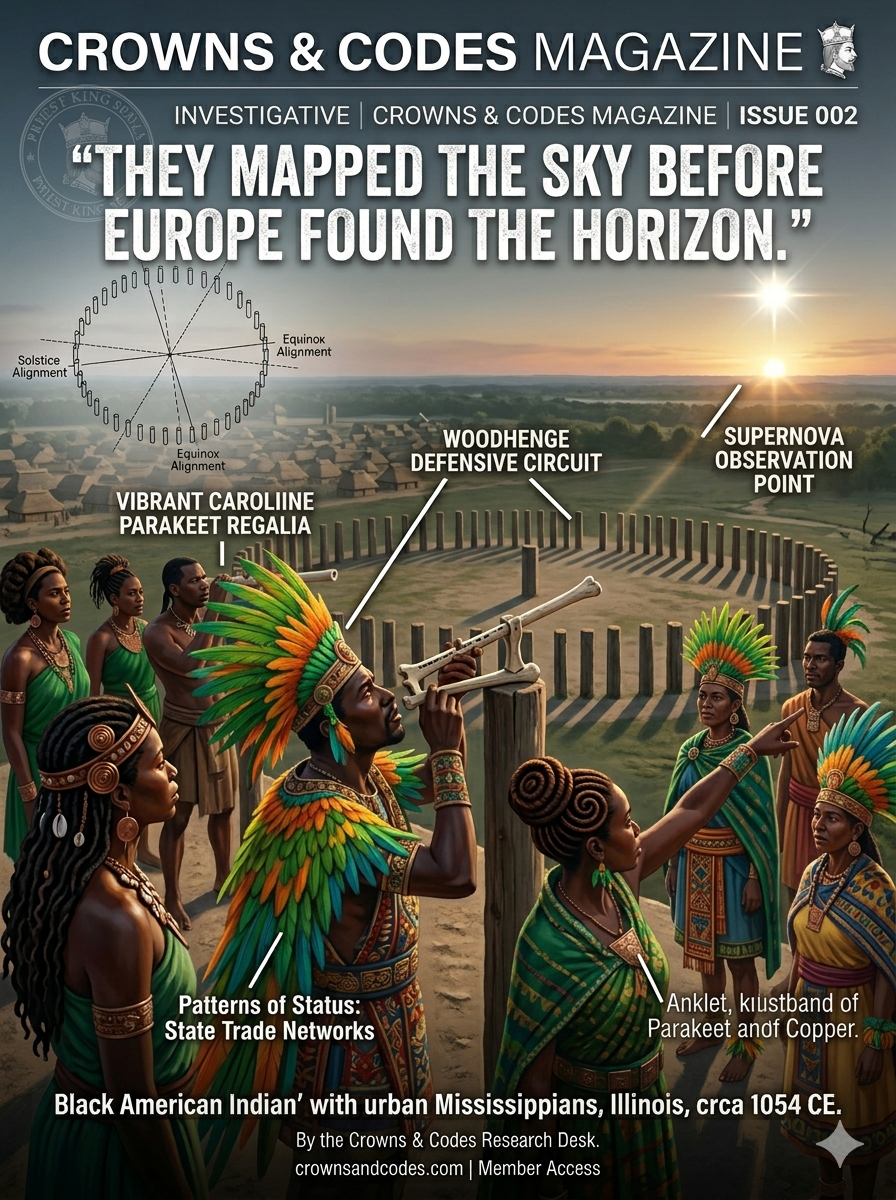
Arranged in a large arc west of Monks Mound were a series of large post holes — not random, but arranged in precise circular patterns, spaced at mathematically deliberate intervals, oriented to specific points on the horizon.
When the archaeologists mapped the alignments, they found that the posts marked the exact positions of sunrise on the winter solstice, the summer solstice, the spring equinox, and the fall equinox.
They called it Woodhenge — the American counterpart to Stonehenge in England.
But Woodhenge was not one structure. It was five. Built and rebuilt over a period of roughly 300 years, each iteration more refined than the last, each one recalibrating the solar alignments to account for the slight wobble in the Earth's axial tilt that shifts solstice positions over centuries.
Read that again.
The Cahokia astronomers knew that the Earth's axis wobbles. They knew it not from a telescope, not from a written mathematical tradition, not from the accumulated library of Greek and Roman texts — but from 300 years of direct, systematic observation recorded in wood and earth and the position of the sunrise on a horizon they had memorized down to the degree.
The Julian calendar that Europe was using in 1054 CE was already accumulating an error of 11 minutes per year — an error that would take until 1582 and the Gregorian reform to correct. The Cahokia Woodhenge, operating on direct solar observation, had no such error. It told the correct date every single day because it was reading the sky directly instead of trusting a calendar someone else had written.
Part Two: What They Actually Knew
The Cahokia Woodhenge is the most documented example, but it is not the only one.
Solar tracking. The solstice and equinox alignments at Cahokia are matched at multiple other Mississippian sites. The Newark Earthworks in Ohio — a complex of geometric mounds and enclosures covering four square miles — contains alignments to the lunar standstill cycle: the 18.6-year cycle in which the moon reaches its maximum and minimum rise and set positions on the horizon. Tracking the lunar standstill requires continuous, systematic observation across nearly two decades. It cannot be done accidentally. It requires institutional memory, a trained observation class, and a physical instrument — which the Newark Earthworks were.
Stellar observation. The 1054 CE supernova petroglyphs found at Chaco Canyon show a crescent moon next to a bright star — an accurate depiction of the sky on the morning of July 5, 1054, when the crescent moon was positioned adjacent to the supernova in the constellation Taurus. This is not artistic coincidence. This is a dated astronomical record. The person who carved it was recording a specific event at a specific time with enough astronomical literacy to include the moon's phase as a timestamp.
Agricultural calendrics. The three-sisters agricultural system — corn, beans, and squash planted in deliberate combination — required precise planting calendars tied to frost dates, soil temperatures, and growing season lengths. The Mississippian agricultural surplus that supported cities of 20,000 people was not possible without a functioning calendar system accurate enough to time planting and harvest across a variable continental climate.
Planetary tracking. Venus appears consistently in the iconography of Mississippian and Southeastern Ceremonial Complex art — the shared artistic and religious tradition connecting mound-building cultures from Wisconsin to Florida. Venus follows a precise 584-day synodic cycle. The Maya, operating in the same cultural sphere, had calculated this cycle to an accuracy of one day in 500 years. The presence of Venus iconography in Mississippian ceremonial objects is not decorative. It is a record of observation.
Part Three: The Comparison They Don't Want You to Make
| European Astronomy (Same Period) | Mississippian Astronomy |
|---|---|
| 1054 CE supernova — zero European records | Anasazi, Hohokam, and Cahokia all documented it |
| Julian calendar accumulating 11 min/year error | Woodhenge calibrated to direct solar observation — no drift |
| First European observatory: Uraniborg, 1576 CE | Cahokia Woodhenge operational: ~900 CE — 676-year head start |
| Telescope invented: 1608 CE | Newark Earthworks lunar standstill alignment: ~1000 CE |
| Gregorian calendar reform correcting Julian error: 1582 CE | Three-sisters agricultural calendar in continuous use for 1,000+ years |
In 1054 CE, when the supernova lit the sky for 23 days, Europe was operating on the Julian calendar — already accumulating a structural error of 11 minutes per year that would take 528 more years to correct.
European universities would not begin systematic astronomical observation until the late 13th century. The first European observatory was not constructed until 1576 CE. The telescope was not invented until 1608.
The Cahokia Woodhenge was built around 900 CE. The Newark Earthworks lunar standstill alignments were calibrated no later than 1000 CE. The Chaco Canyon supernova petroglyph was carved in 1054 CE — the same year Europe didn't notice the sky was on fire.
The civilization that built these instruments was not primitive. It was not pre-scientific. It was not waiting to be discovered.
It was already here. It had already done the work.
And the people carrying that knowledge forward — through removal, through reclassification, through a century of legal erasure — are still here too.